


Stamped concrete problems in West Michigan fall into a few predictable categories: sealer failure, color fading, freeze-thaw cracking, efflorescence, and installation errors. Most are preventable with proper installation and a resealing schedule timed to Michigan’s climate. Nearly all can be fixed without a full tear-out. Cole Concrete has been installing stamped concrete across Grand Rapids since 2016, and the issues we usually see are mostly related to how water and salt interact with the surface during a West Michigan winter.
What goes wrong five or ten years after the pour, and how much is avoidable from day one? Michigan’s freeze-thaw cycles put stamped surfaces through 40 to 60 full cycles each winter. Each one is a chance for trapped water to expand and start a problem the sealer was supposed to stop. The issues below range from afternoon DIY fixes to problems needing a contractor with stamping experience.
Sealer Failure and Color Fading

Most homeowners notice their stamped concrete losing its luster long before the structural concrete itself fails, typically due to the natural breakdown of the protective sealer over time.
What Sealer Failure Looks Like
Sealer failure is the most common problem West Michigan homeowners call about. It shows up as a cloudy white haze, peeling patches, or spots where water no longer beads. The sealer is the sacrificial layer. It takes UV exposure, foot traffic, and winter salt so the concrete underneath doesn’t have to. Michigan’s mix of summer UV and winter deicing salts cuts sealer life to two to three years.
Why Color Fading Is Usually a Sealer Problem
Color fading is usually a sealer problem in disguise. Integral pigment mixed into the concrete can’t fade. What looks like fading is the sealer yellowing on top. Stripping the old sealer and applying fresh high-solids acrylic usually as part of stamped concrete maintenance restores the original color. Once bare concrete sits through a winter of road salt, the surface etches and requires resurfacing rather than a simple recolor.
Freeze-Thaw Cracking and Efflorescence
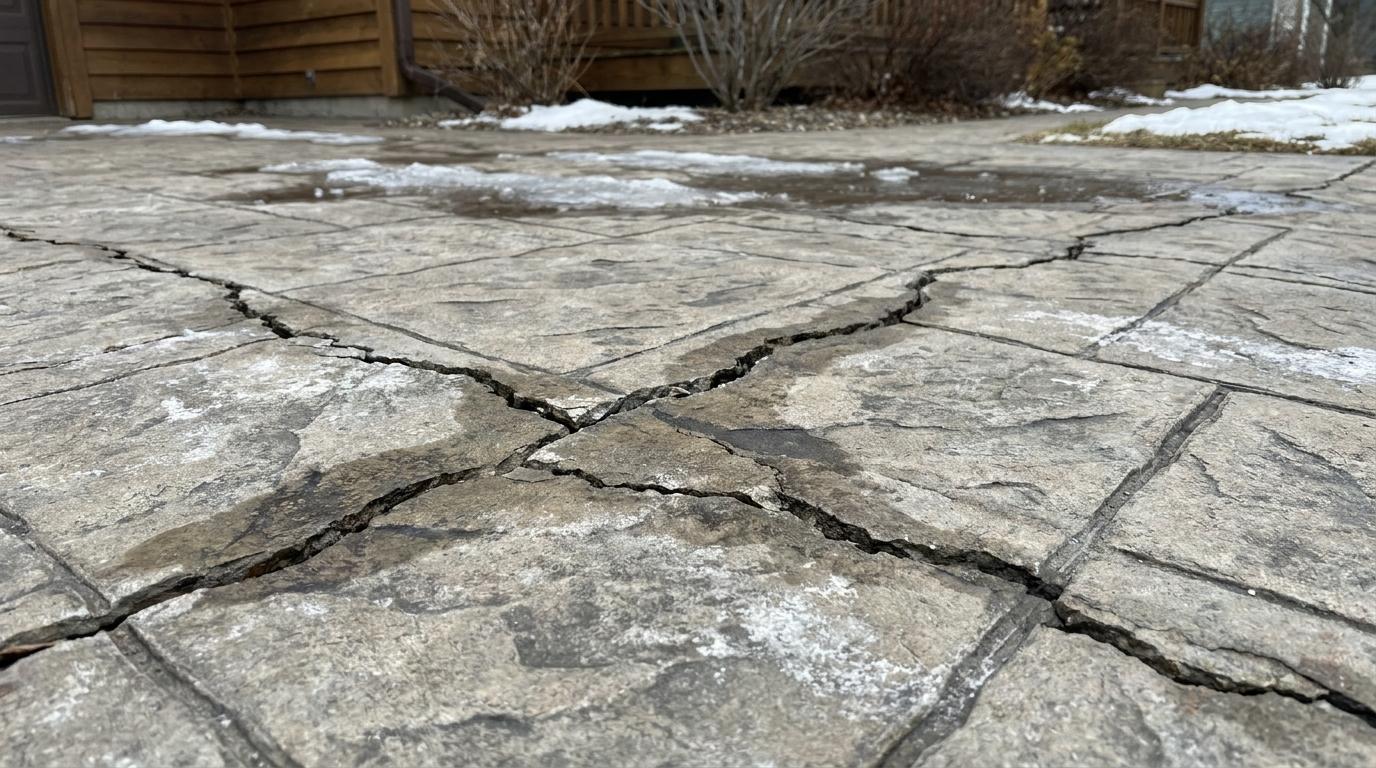
Michigan’s climate presents unique challenges for stamped concrete, where fluctuating temperatures and trapped moisture can lead to inevitable cracking and the appearance of efflorescence.
How Freeze-Thaw Cycles Widen Cracks
Concrete is guaranteed to crack. It’s just the nature of the material, not a flaw in the workmanship. But West Michigan’s freeze-thaw cycle accelerates it. Water seeps into hairline cracks, freezes, and expands by roughly 9% in volume, wedging the crack wider. This is why control joints are important. These areas are pre-cut lines that basically let the concrete crack in a way that doesn’t cause structural damage. If joints were skipped or spaced too far apart, uncontrolled freeze-thaw cracking is nearly certain within three to five years.
What Efflorescence Means and When to Worry
Efflorescence, a white chalky powder in the low points of the stamp pattern, looks worse than it is. It’s simply harmless mineral salts carried to the surface by moisture. A dry stiff-bristle brush removes light cases. If it keeps returning, persistent moisture under the slab is the culprit.
Cole Concrete addresses common concrete problems like cracking and efflorescence by evaluating the slab, subgrade, and drainage together. Treating just the surface without fixing the water source means repeating the repair in two years.
Installation Errors That Show Up Later

Some problems trace back to the day of the pour: stamp patterns that don’t line up across adjacent sections, inconsistent texture depth, visible color banding, and stamp slump where the mat pushes wet concrete sideways. These are largely due to crew experience. After the concrete is poured, there’s a narrow window for stamping, and Michigan’s daily temperature swings make that timing harder to get right.
For homeowners evaluating a contractor, Cole Concrete recommends reviewing examples of locally completed stamped concrete projects.A portfolio that features work from another state tells you nothing about how that work holds up through a West Michigan winter. Errors in the pattern are cosmetic and livable, but errors in base preparation turn into structural problems that no sealer can fix.
Frequently Asked Questions
What is the life expectancy of stamped concrete?
Properly installed stamped concrete in West Michigan lasts 25 to 30 years with resealing every two to three years. The concrete itself can last 50-plus years structurally; what degrades first is the surface sealer, which is a sacrificial wear layer. Without sealer maintenance, visible deterioration can start within five to seven years in Michigan’s climate.
Does stamped concrete crack more easily than regular concrete?
Stamped concrete does not crack more easily than regular concrete; both share the same structural properties. The difference is that cracks in stamped concrete are more noticeable because they interrupt a decorative pattern. We see this on stamped patios around Holland, where a hairline crack that would vanish on a plain gray slab stands out because it cuts across the stone pattern. Cracking risk depends on the same factors for both: subgrade compaction, proper control joint spacing, and adequate reinforcement.
Can you fix faded stamped concrete without replacing it?
Yes, faded stamped concrete can almost always be restored without replacement. If the fade is in the sealer layer, which accounts for most cases, stripping the old sealer and applying a fresh coat restores the original color. If the color hardener has worn thin, an acetone-based concrete stain or tinted sealer can recolor the surface. Full replacement is only needed when the concrete is structurally compromised.
Protect Your Stamped Concrete Investment

Most stamped concrete problems in West Michigan follow a pattern: the sealer degrades, water gets in, freeze-thaw cycles do the damage, and a cosmetic issue becomes structural. A two-to three-year resealing schedule prevent them from occurring. Catching a worn sealer early means spending a few hundred dollars in maintenance rather than thousands in repairs.
Contact Cole Concrete at (231) 349-2883 for a free estimate on stamped concrete repair, resealing, or a new installation built for Michigan winters.

Dylan Cole is the owner of Cole Concrete, a concrete company committed to delivering quality craftsmanship and dependable service. With a passion for the trade and a personal stake in every job, Dyan and her team take pride in providing reliable concrete solutions for residential and commercial clients alike.